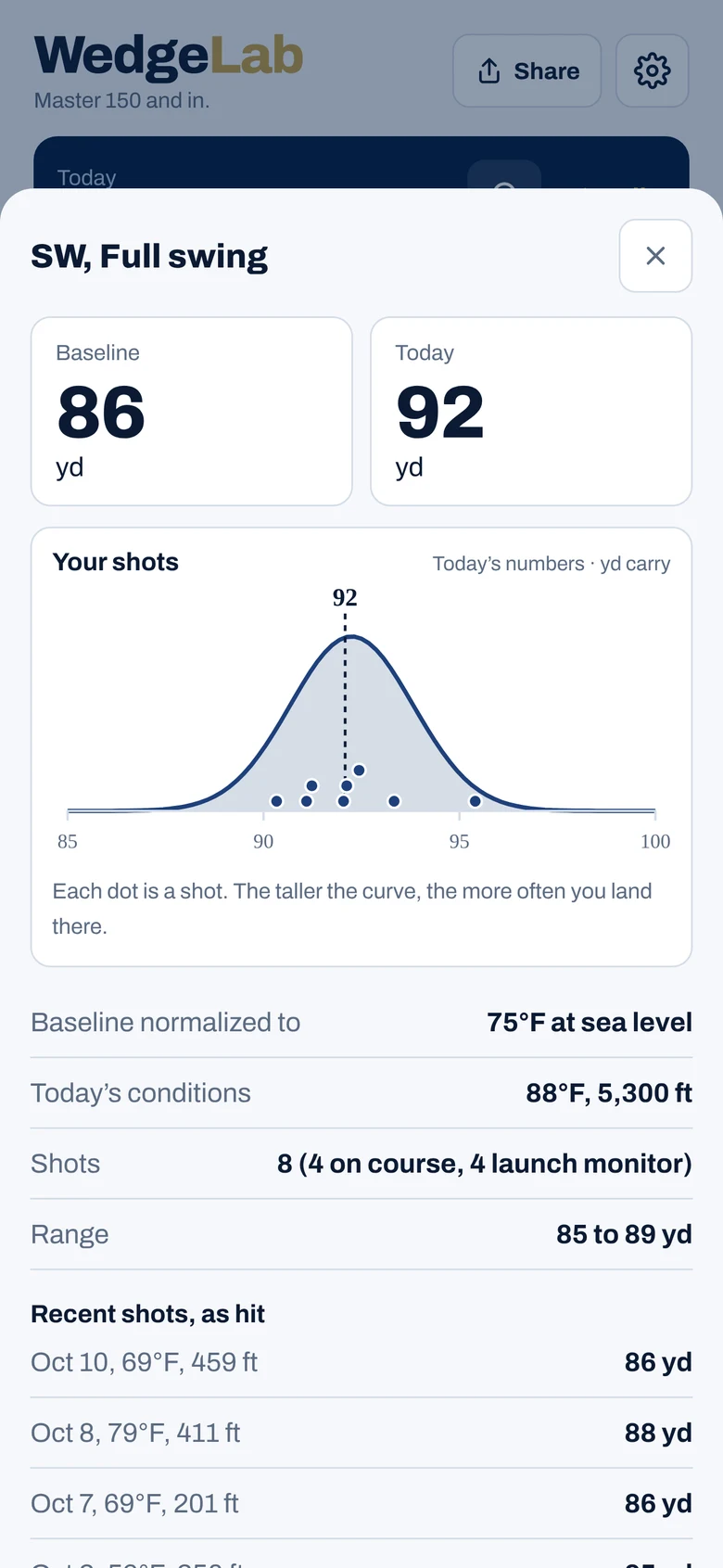
Your own carry numbers for every wedge and every swing, adjusted for the temperature and elevation you’re playing in today.
Coming soon to the App StoreConfidence comes from knowing exactly how far each swing carries. WedgeLab turns your own shots into numbers you can count on.
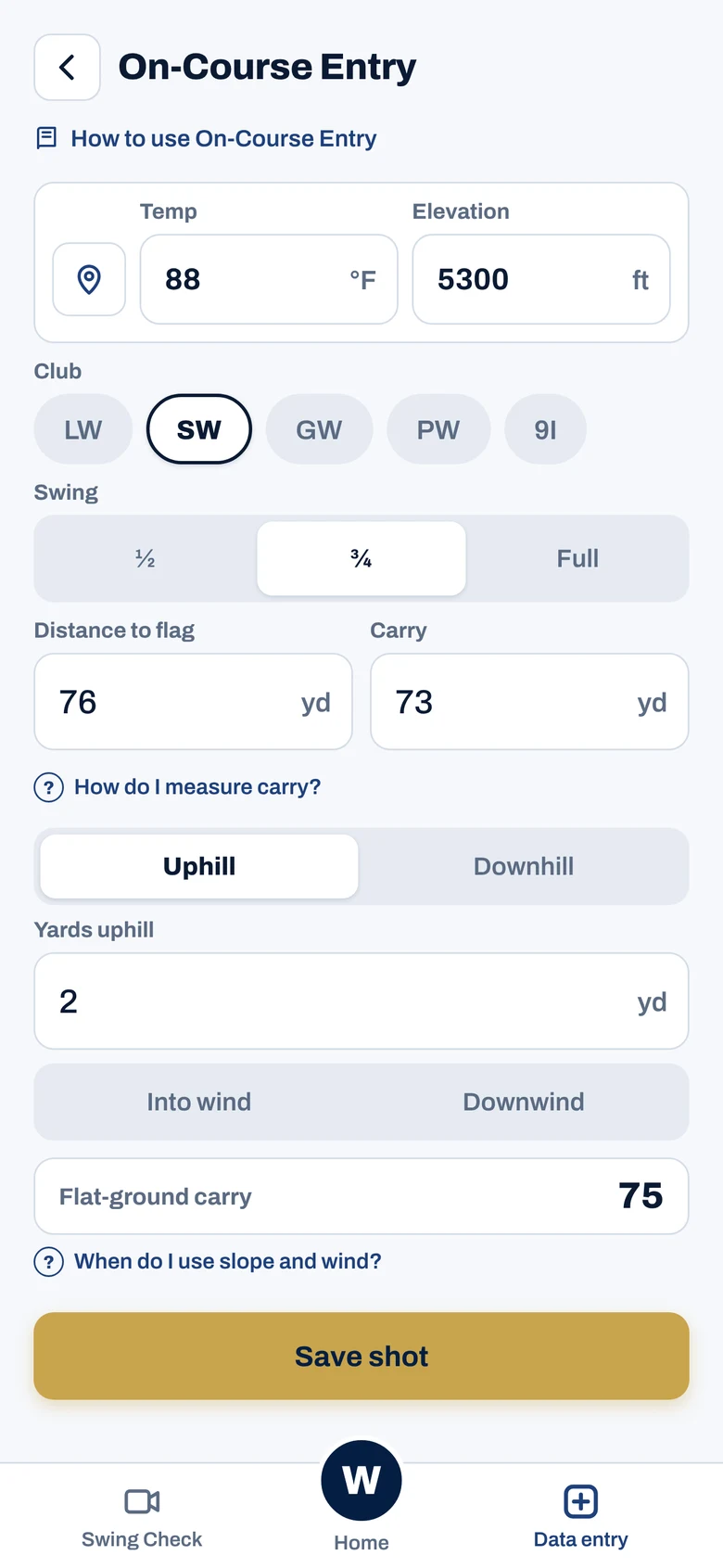
On the course, pace off from the flag to the pitch mark. On a launch monitor, type each carry. Either way takes seconds.
Every club and swing gets its own number from your shots. Five shots in and it turns green: a number you can trust.
Enter today’s temperature and elevation, or tap for your location, and every number moves to what it carries right now.

Tap any number to see every shot behind it. The curve shows how tightly your shots land, so you know exactly how much to trust it.

Distance to the flag, where it landed, and you’re done. Uphill, downhill or a light breeze? Add the yards and WedgeLab works out the flat-ground carry.
Put a practice swing beside the sand wedge swing that built your number. Trim both to start together, play them frame by frame, and draw lines right on the video.
I’m Lou Olsakovsky. I started at Allegheny College, a Division III school, because no Division I program offered me a spot. I transferred to Penn State, where a COVID year gave me four seasons. I captained the team in 2021–22 and qualified for an NCAA Regional as an individual in 2022.
I struck the ball well and drove it a long way. But inside 150 yards I had doubt, and in tournaments I didn’t fully trust myself.
Before my fifth year I built a system. I learned everything I could about why a golf ball flies the distance it does, measured my own wedges, and adjusted every number for the conditions. The first version of WedgeLab was a spreadsheet.
My fifth year was my best. WedgeLab is that system, built so every player can have numbers they trust.
Warm air and elevation help a full swing more than a soft pitch, so the adjustment grows with how far the shot carries. Tuned to TrackMan launch monitor research.
today = baseline
× (1 + 0.008 · (carry / 100) · (T − 75) / 10)
× (1 + 0.013 · (carry / 100) · elevation / 1000)
Example: a 101-yard sand wedge at sea level and 75°F carries about 109 yards at 90°F and 5,300 ft.
WedgeLab is coming soon to the App Store for iPhone. Follow along at wedgelab.app for the launch.
The free version covers your lob, sand and gap wedges with the ½ · ¾ · Full system, both entry types, and your baseline numbers. WedgeLab Pro ($6.99 a month or $49.99 a year) adds the pitching wedge and 9 iron, today’s adjusted numbers, a custom swing system, and Swing Check.
No. On-Course Entry works with just a rangefinder or the yardage on a sprinkler head: distance to the flag, and the paces from the flag to the pitch mark.
It is tuned to TrackMan launch monitor research and ball-flight physics. A 100-yard shot moves about 0.8% per 10°F and 1.3% per 1,000 ft; longer shots move more and short pitches less, because a slower ball is less affected by the air. Because every shot is normalized the same way, your numbers stay fair whether you practiced on a cold morning or a hot afternoon. More on the Support page.